Friday, 25 May 2012

Evaluation Unit 67 3D Animation Timed Assessment

Evaluation

For Unit 67, our 3D animation project we were tasked with creating an animation using 3DS Max. We were given a choice of whether to include the 3D assets we created in our Unit 66 unit or create new assets and include them in the animation. I decided i was going to do both, use asset(s) i had already created. My Fortis Defendre and create some new assets to work with it.
The plan i came up with was to create an island in the middle of the sea/ocean and have a fly-by of my Ship (Fortis Defendre) and include an explosion on the island, then have the shock wave of the explosion expand out from the island and hit the shields of the ship before it dissipates and the screen fades to black. The camera would also be moving towards the ship & island whilst orbiting the scene.

In the end the majority of the finished animation met my initial plans and intentions. I managed to create an island using a displacement map of Stewart's Island, i altered some of the settings to raise the bitmap texture of the island i had applied to a plane. Once this was done i needed to create the water for the island to sit on, this was done using a plane and applying a texture to it to imitate the ripples of water. I achieved this by using video tutorials on YouTube and although i managed to create the water texture and successfully applied it to the plane, it didn't have any blue tint to it and so the water was silverish and highly reflective. Although this is not what i had originally intended or wanted the end result was quite appealing so i kept it.

Because i had managed my time effectively i had more time that i had originally planned to edit the background assets for my scene, this involved creating a sky-box using a sphere, sky map, creating a sun using a light source asset and then some (a lot of) tweaking of textures and positioning of the light and sky. Once the skybox was up it reflected really well on my silvery sea, which i was really happy about.

Unusually for me on a final piece, i managed my time quite well, i had everything planned out and ready. as most of the assets were already created there wasn't a lot to do in the way of modelling so most of my time went into researching tutorials and animating. However the texturing and lighting took the most time as the positioning of the sky-box texture and the light source had to be pretty much perfect. This and fixing my island so that the edges of the plane i applied the island displacement map was applied to laid below the surface of the water plane, this however i failed to resolve before submission. I did, surprisingly  find creating the effects relatively easy and enjoyable, i spent allot of time researching tutorials on how best to make them and then implementing them in my work.

As this was my first 3D animation it doesn't really compare to any proffessional example, however i did try to imitate certain effects and camera shots i had seen in CGI from sci-fi films/TV shows and games i drew inspiration from, but i had minimal success.
Some of my class mates liked and found my highly reflective silver ocean amusing and good, complimenting me on my use of effects. However i could use more practice at this and improve upon it. Overall i believe the animation i made was a success and i doubt i would do anything differently given the chance.

Saturday, 5 May 2012

Unit 33 Stop Motion Animation Research


Stop Motion Animation

Understanding the techniques and development of stop motion animation.

Persistence of vision

Persistence of vision is a theory that is most directly applied to animation. it is a simple yet controversial concept that states that the eye in conjunction with the brain can only process a certain number of images per second, and by flying these images at the viewer sequentially you create the illusion of motion from still images.

What this essentially means is the more images and the faster in succession these images are presented to the viewer means the easier and smother they seem to flow creating the illusion of actual motion where actually there is none.

"Persistence of vision is a commonly-accepted although somewhat controversial theory which states that the human eye always retains images for a fraction of a second (around 0.04 second). This means that everything we see is a subtle blend of what is happening now and what happened a fraction of a second ago."

(below is the end product of my experimentation with stop motion/flip books)


Stop Frame

In relation to animated films stop-frame animation is the process of creating an animation by photographing each frame individually and then piecing them together piece by piece (or by use of an app, such as the Stop Motion Maker - KomaDori, like i used in the above video).

It is most commonly used in in claymation and puppet based animation, the objects are brought to life by incrementally breaking up the figures motion and filming one frame of film per increment.

This technique is almost as old as film it's self. Film makers needed a way to animate objects on screen so the technique was devised. The earliest credited usage was in 1897 when J. Stuart Blackton and Albert E. Smith brought a toy circus alive in Humpty Dumpty Circus.

(below you will find a bunch of images i used to make my above animation of a rocket launching)


Frame Rates

Frame Rates are how many images of a movie are displayed every second a movie is played. The higher the frame rate the move has, the smoother objects move in the movie. Frame rates are measured in FPS or Frames Per Second.

If you compare a movie with low FPS to a movie with high FPS, the movie with a higher FPS has more frames for the same number of seconds of film. It will also be stored in a larger file. Game frames are essentially the same thing, the only difference between a movie and game frames is that game frames are created as you play whereas movie frames are recreated from a file.

Different forms of film in different areas are shown at different FPS:
. Films in cinemas are shown at 24 FPS.
. TV shows are broadcast at 50FPS in PAL(Europe) and Secam(Asia) formats.
. In the USA the TV format is NTSC broadcast at 60 FPS and is updated at 30 FPS.

The human eyes detect images at well over 200/300FPS but in combination with the brain, most of this information is stripped away effectively limiting it to 20 or so FPS.

Development

Pioneers

Joseph Plateau:


Joseph Plateau was born in Bruxelles (Brussels) in 1801. in 1822 Plateau graduated from the Athenaeum, his tutor advised him to study literature and philosophy at the University of Liege, with the aim of studying Law. Law was a natural choice as his guardian was a lawyer, however he wanted to go on to do the subjects he loved, and chose to study them after gaining a bachelors degree in law.

The Phenakistoscope

The Phenakistoscope (meaning deceptive view) is a toy that was created by Joseph Platue in 1832. much like other early animation devices such as the Thaumatrope, it uses the persistence of vision to achieve the illusion. The only other things required to view the animation is a mirror and a push pin.

"The user holds the Phenakistoscope up to a mirror, with the animated side facing away from them and spins it around the push pin while looking through the slots. This creates a strobing effect, with each slot allowing only a brief view of the animated side, and each time showing a slightly different view of it."

(this was the only one of the animators that i couldn't record the effect of, this was because the effect produced by the animator could not be picked up, it instead only picked up the movement of the wheel it's self.)

William Horner:


William George Horner, born 1786 was a British mathematician and school master. he is best known and widely only remembered for the Horner's Method of solving algebraic equations ascribed to him by Augustus De Morgan and others.

The invention of the Zoetrope in 1834 (then under the name Daedaleum) has been attributed to him.


Zoetrope

The Zoetrope was created in 1834 by William Horner, then called the Daedaleum, meaning 'The Wheel of the Devil'. The Daedaleum didn't become popular until the 1860's when it was patented in both England and America, which is when it was given its current and well known name by William F. Lincoln, Zoetrope, which means 'Wheel of Life'.

The Zoetrope works of the same principles as the Phenakistoscope, however the pictures were drawn on a strip which would sit in the bottom third of a metal drum with slits cut into the upper section of the drum.

"The drum was mounted on a spindle so that it could be spun, and viewers looking through the slits would see the cartoon strip form a moving image. The faster the drum is spun, the smoother the image that is produced."

Charles-Émile Reynaud:


Emile Reynaud was a French inventor, artist and showman. born on 8 December 1844 to horologer and medal engraver Benoit- Clade-Brutus Reynaud and artist and school teacher Marie-Caroline Bellanger. From an early age his parents took care of his education, as such he learned skills such as; precision mechanics from his father and his mother taught him to draw and paint. At 14 he was already very knowledgeable in literary and scientific matters, apprenticing to a precision engineer in Paris and later studying with photographer and sculpter Adoam Salomon.

When he was 29 he became a professor of physics and natural sciences which he taught from 1873 to 1877. It was during this time that he created the Praxinoscope, his most famous and notable invention. He moved into an apartment at the Rue Rodier in Paris with his mother. Using the adjacent apartment as a workshop where the Praxinoscope were produced.

Praxinoscope

The Praxinoscope was invented in 1877 by French inventor Charles-Emile Reynaud, it is a precursor of the moving picture. the Praxinoscope functions by having a band of pictures, each slightly different to its neighbour, is placed inside a rotating drum (similar to the arrangement in the Zoetrope).
In his original design of the Praxinoscope, the pictures were viewed by reflection through a series of narrow vertical mirrors placed at the centre of the drum.

"The drum is spun by hand, and the horse appears to gallop."

Thomas Edison:


Thomas Alva Edison was born 11 February 1847 into a middle-class family, he was the youngest of 7 children and the slowest to develop, he didn't learn to speak until the age of four. Because of this he began to ask any and every adult he met to explain to him how everything he encountered worked.
After this insistent and seemingly self-centred behaviour finally broke his over worked and short tempered teacher, his mother pulled him out of school to be home taught. His mother whom firmly believed that his unusually broad forehead and larger that average head only served as proof of his remarkable intelligence.

Because of his poor hearing, he was unable to take advantage of a contemporary secondary education in maths, physics and engineering, this however never stopped him finding ways of absorbing the knowledge he desired, and developed his own individualistic style of learning.

Kinetoscope

The Kinetoscope was originally envisioned by Thomas Edison in the early 1880's filing his first patent in October of 1888. however the Kinetoscope which became the final product, was mostly worked on by Edison's assistant W.K.L Dickson whom Edison hired in the Spring of 1883.

One of the most challenging aspects of creating the Kinetoscope, was the design and creation of the photographic medium for presenting the micro-photographs, the breakthrough for this problem came with the launch of photographic quality celluloid by John Carbutt.

"The initial prototype was actually a 'taking device' - camera, but could be converted to a projector by shining a light through the film and lens."


The peep-hole version which is recognised as 'The Kinetoscope' was ready in a prototype version by the end of Summer 1892, the mechanism was contained in a wooden cabinet with a peep-hole in the top with which people could view the film through.


Developers

Ray Harryhausen


Ray Harryhausen was born on the 29th June 1920. Growing up his parents always encouraged and never dissuaded Ray from his unusual obsession with fantasy and films.

Ray Harryhausen stands out as being one of the most successful and greatest stop-motion animators of ll time, the other being Willis O'Brian, and 3 decades kept his unique field alive almost single handedly.

Ray made his name in the 50's through 70's by creating fantastical stories and creatures based on myths and legends, thus creating a unique genre of fantasy films that took the movie making world by storm.

Some of Ray's most notable works are; The Beast From 20,000 Fathoms (1952), It Came From Beneath The Sea (1955), Jason And The Argonauts (my personal favourite) (1963), The Golden Voyage Of Sinbad (1973).


Jan Svankmajer

Jan Svankmajer is one of the greatest Czech fimakers, he was born in 1934 in Prague where he still lives. Jan has trained at the Institute of Applied Arts and at the Prague Academy of Performing Arts (Department of Puppetry). during this time he became involved in the Theater of Masks and the Black Theater.

Making his first film in 1964, for over 30 years Jan has made some of the most memorable and unique animated films ever made. As such he has gained a reputation as one of the worlds foremost and renown animators, influencing the best of the modern filmmakers from Tim Burton to the Brothers Quay.

Some of Jan Svankmajer's work includes; Alice (1988), Faust (1995), Scenes From the Surreal (1999).


The Brothers Quay

Stephen and Timothy Quay (known as the Quay Brothers) are two of the worlds most original filmmakers. Stephen and Timothy Quay are identical twin brothers born on 17th June 1947 in norristown Pennsylvania. During their time studying in Pennsylvania they would begin studying the films and works of Luis Bunuel, Carl Theodor Dreyer as well as, Andrei Tarkovsky and Ingmar Bergman.

These screenings would be incredibly influential for them, resulting in them deciding to create their own films. After graduation in 1969, they moved to study in England, it was at this time that they would make three short animated films: Der Der Loop Loop, II Duetto and Palace in Flames.

A short list of a few of their films and projects other the years (including both live action and animation).


Tim Burton

Tim Burton, Born 25th August 1958 in Burbank, California. From a young age Burton was a huge fan of monster movies, such as: Godzilla, The hammer Horror Films and the work of Ray Harryhausen. In 1976 he attended the California institute of the Arts after a few years in 1979 he was drafted to join the Disney animator ranks working on The Fox and the Hound. In the next few years he found the work as an animator tedious, and it "bored him silly". Disney chose to make him a conceptual artist, beginning work on the animated movie 'The Black Cauldron' this work was seen as too 'dark' so it was not used, he was instead set loose on his own project, which would, years later, become The Nightmare Before Christmas.

He would later go on to make some of the greatest animated and live action films of all time, including:


Aardman Animations

Aardman Animations is a British animation studio, best known for its clay animation works, such as the adventures of Wallace and Gromit. Aardman Animations was founded in 1972 by Peter Lord and David Sproxton to realise their dreams of creating an animated picture. In 1975 they created a segment called Greeblies using clay animation, which became the basis and inspiration for creating Morph, the iconic simple clay character.

In 1997 Aardman and DreamWorks teamed up to create the animated film Chicken Run, Aardmans first film. released in 2000 Chicken Run was a great financial and critical success.

in 2005 after 10 years Wallace and Gromit returned in Wallace and Gromit: The Curse Of The Wear-Rabbit. The following year they created their first computer animated feature, Flushed Away.

Monday, 30 April 2012

First Attempt at Creating a Flip-book or Stop-motion Animation


In todays lesson we were tasked with creating a flip book so that we could experiment with different forms of animation and learn about persistance of vision (see my previous post).
I decided to make my flip book about the launch of a missile, once it reached orbit it cuts it's engine and transforms into a satelite and opens fire on a city on the planet, the smoke is then erased to show the end image, a simple "THE END"

We were all creating our flip-books and whilst creating mine I realised I did it the wrong way around, so after erasing and then recreating my flip-book I realised that the paper I drew it on was too thick to flip.
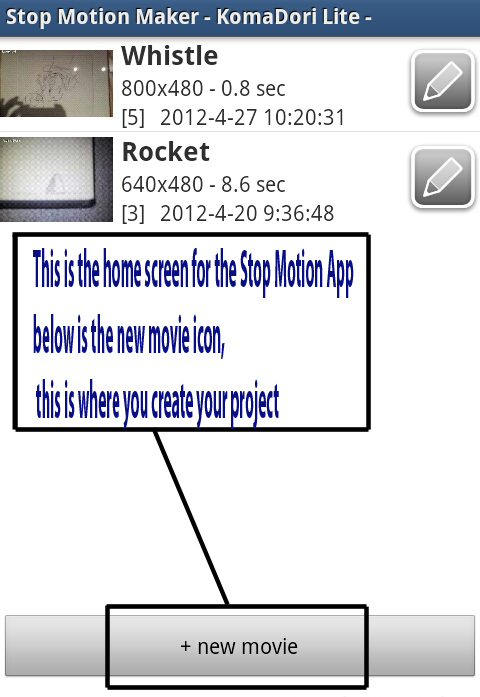
In order to finish the work set to us and salvage all the drawings I had done, I decided to seek salvation in the Android (Google Play) market place. After 2 minutes of searching I found salvation in the form of the Stop Motion Maker - KomaDori app, which is designed to quickly and effectivly create a stop motion animation with much of the hard work cut out.
'the Stop Motion Maker app on the android market place'


I began taking pictures of the images I had so far created using the app to first test make sure the animator worked, after a quick test I found it did indeed work and decided to proceed working on the rest of the animation.


The app works by allowing you to create a project, within which to store all of your images.


When created the app asks you to pick a resolution for the camera. All images are taken by the in app camera which can be set to be operated automatic (the camera captures images every fraction of a second or so) or manual (all camera functions are operated manually by the user).


After this the app takes you to the camera where to take a photo you just tap the screen, after you have taken all the photo's you wish to put in you animation you just click the exit button to take you to the view project section.


The view project screen, is a screen that the app takes you to when your project is completed, here you can go over your work and make sure it works the you want it.


When you have created your project you can go back and select edit mode


 On the edit screen the app allows you to save, add new images to or delete your project, you can also preview it.

Saturday, 31 March 2012

Unit 69 Concept Art

In this post i am going to put up images of all of the concept art i have created for my Unit 69 work

--Concept sketch for Panel 2 of Page 1--
 --Original hand drawn version of Page 1--
--Original hand drawn version of Page 2--
 --Original hand drawn version of Page 3--
 --Original hand drawn version of Page 4--
 --Original hand drawn version of Page 5--
-- Concept art for an Assassin character not included in the final comic--
--Concept art for a Fallen Angel not included in the final comic--
--Initial concept drawing of the Leviathan--
--Initial concept sketch for Marisha The Black Witch--
--Final concept sketch for Marisha The Black Witch--
--Initial concept sketch for Saris and Tora--
--Final concept sketch of Saris and second concept sketch of Tora--
--Final concept sketch of Tora--
--Emblem design for L.E.G.I.O.N.--

Tuesday, 20 March 2012

Concept Work


I really don't have enough on this blog, so in the next 2 weeks or so,(time allowing) I should be posting new concept art and 3D work that I'm currently working on, and maybe some of my older stuff.


(Above: This is a water colour painting I did in sixth form as part of my war propaganda pieces for my final exam.)

(Above: This is a painting of the man (dubbed vans man) from the side of my vans trainers, i painted it on my bedroom wall in acrylic paint.)

Friday, 2 March 2012

Action Plan - Flash Work

Today i showed my animation work to the class, I presented and explained the 2 peices of work i showed, my opening flash screen and my comic strip which was in the process of being edited in flash. because3 i have not completed my flash work yet or included the animation i explained to the class what i would be doing not what i have done.

the opening screen will be designed to be like some kind of futuristic/sci-fi OS (Operating System) i will design it so that part of the animation (the parts which show access denied/access granted) one will lead to the comic the others will show access denied, this will be tied in with my comic in the sense that my comic is told in a way that shows one of my characters (saris) looking back on the events after they have happened.

from the feedback i got from the class i have determined what my action plan should be, that is:
- complete my trace in flash for at least 1 page (but preferably all of them).
- turn at least 1 of said pages into an animation that helps tell the story of my comic
The main feed back i got from the class was that it was unfinished and that my concept sketches were good.

In the next 10 hours we have for our Friday lessons i will be finishing my flash work, both finishing my comic with some form of digital editing (Flash & Photo Shop) and also creating my animation, for Mel and Chris' work respectively.